
All-Season vs. Winter Tires: What’s the Real Difference?
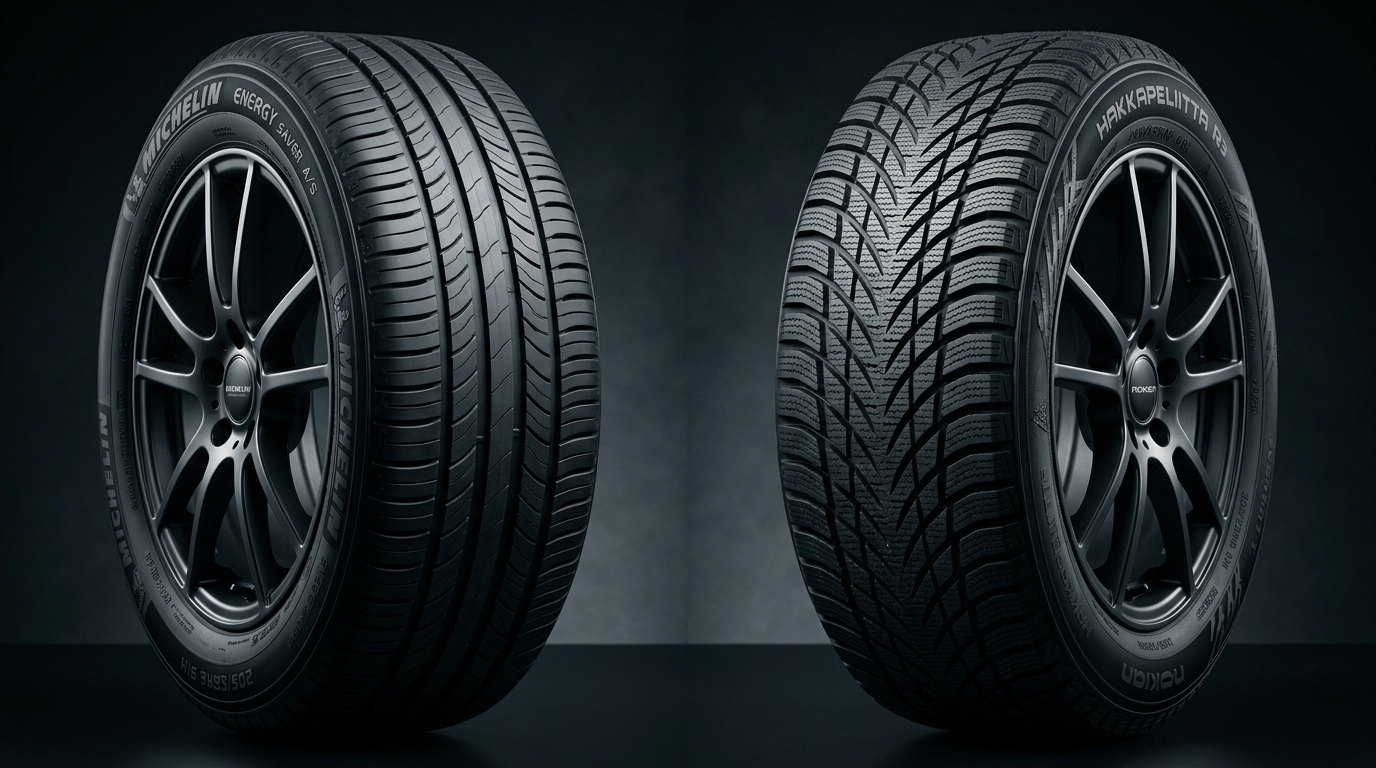
People ask if all-seasons are “good enough” for winter here. Sometimes, in a light year, on salted main roads, with careful driving — you get away with it.
Getting away with it is not the same as having the right tire.
Rubber compound
All-seasons are tuned to survive summer heat. In the cold they firm up. Winters stay softer so the tread can still bite.
That is why the 7°C rule keeps coming up in our bays.
Tread and sipes
Winter tires are cut with lots of small slits — sipes — that open as the tire rolls and grab ice. Deep channels also pack snow. Snow-on-snow can grip better than rubber-on-snow, which sounds wrong until you have felt it.
All-seasons have fewer of those tricks because they also have to behave in July.
Stopping distance is the part people remember
On packed snow below freezing, winters can shorten a stop by roughly a couple of car lengths versus worn all-seasons at city speeds. Exact numbers vary by car and tire — the direction does not.
If you only remember one thing: cold + all-season + panic stop is a bad combo.
So what should you run?
- Mostly highway and city, park in a garage, rarely drive in storms: some customers still choose a quality all-season and accept the limit
- Early commutes, rural roads, hills, or regular winter weather: dedicated winters
- Black ice and untreated back roads: look at studdable winters and the legal stud windows
Ready to compare sets? Browse tires or book a fitment chat. We will tell you straight if an all-season is a poor match for how you drive.
Common questions
Are “all-weather” tires the same as all-season?
No. All-weather tires (with the severe snow symbol) are a different category — better cold performance than basic all-seasons, still not identical to a dedicated winter in deep winter use.
Do I need winters on all four corners?
Yes. Mixing winters on the drive axle only can upset handling. Four matching winters.
Can you store my summers?
Ask your location — seasonal storage options vary by shop. Start at locations.